Roulette odds depend on two things: how many numbers your bet covers and which wheel you play. Every bet pays slightly less than its true odds, so a single-zero wheel keeps 2.70% of every stake on average and a double-zero wheel keeps 5.26%.
This guide lists the chance of winning and the payout for every standard bet, shows the simple maths behind them, and explains the few rules that change the cost. If you are new to the game, the roulette guides cover how a round works first.
What are the odds for each roulette bet?
Your chance of winning a roulette bet is the number of pockets it covers divided by the pockets on the wheel: 37 on a European wheel (0 to 36) and 38 on an American wheel (0, 00 and 1 to 36). A bet on red covers 18 pockets, so it wins 18 times in 37 on a European wheel, or 48.65% of spins.
The table below shows every standard bet, what it pays, and how often it wins on each wheel.
| Bet | Numbers covered | Pays | Chance to win, European wheel | Chance to win, American wheel |
|---|---|---|---|---|
| Straight up | 1 | 35 to 1 | 2.70% | 2.63% |
| Split | 2 | 17 to 1 | 5.41% | 5.26% |
| Street | 3 | 11 to 1 | 8.11% | 7.89% |
| Corner | 4 | 8 to 1 | 10.81% | 10.53% |
| Top line (0, 00, 1, 2, 3) | 5 | 6 to 1 | Not offered | 13.16% |
| Six line | 6 | 5 to 1 | 16.22% | 15.79% |
| Dozen or column | 12 | 2 to 1 | 32.43% | 31.58% |
| Red, black, odd, even, 1 to 18, 19 to 36 | 18 | 1 to 1 | 48.65% | 47.37% |
The payouts in the table match the minimum odds in New Jersey’s roulette payout rule (N.J.A.C. 13:69F-5.2), which lists 35 to 1 for a single number down to 1 to 1 for red, black, odd, even, high and low. Most casinos worldwide pay the same.
How do you calculate roulette odds and payouts?
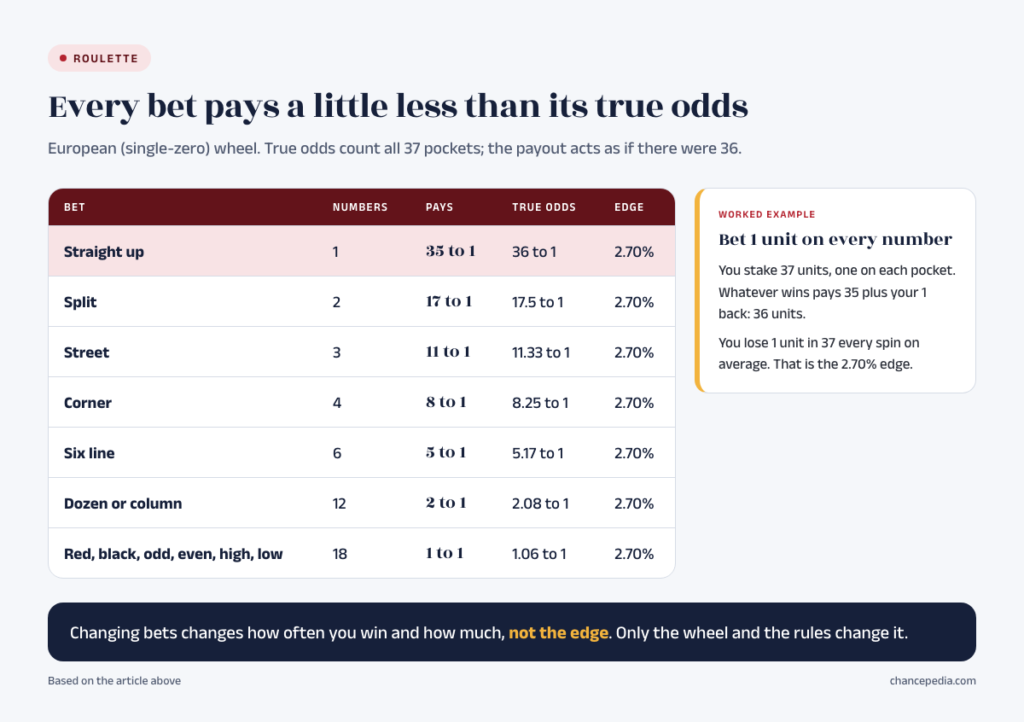
Roulette payouts are set as if the wheel had 36 pockets. Divide 36 by the numbers your bet covers and subtract 1 to get the payout: a three-number street pays 36 ÷ 3 − 1 = 11 to 1. The true odds use all 37 or 38 pockets, and that gap is where the house edge comes from.
Here is the same calculation as a worked example for a single number on a European wheel:
- Count the losing pockets. One pocket wins and 36 lose, so the true odds are 36 to 1.
- Compare with the payout. The bet pays 35 to 1, one unit less than the true odds.
- Work out the average result. Bet 1 unit on all 37 numbers. You stake 37 units, the winning number returns 36 (35 plus your stake), and you are 1 unit down. One unit lost in 37 staked is 2.70%.
Why does every roulette bet have the same house edge?
Every roulette bet has the same house edge because every payout is built on the same 36-pocket assumption. On a European wheel the zero is the one pocket nobody is paid for, so each bet loses 1/37 of its stake on average, which is 2.70%. On an American wheel the 0 and 00 together cost 2/38, which is 5.26%.
You can check this with any bet. A $10 bet on red on a European wheel wins $10 in 18 spins out of 37 and loses $10 in 19. The average result is 10 × (18 − 19) ÷ 37, a loss of about 27 cents per spin. A $10 straight-up bet wins $350 once in 37 spins and loses $10 the other 36 times, which averages out to the same 27 cents.
Mathematics lecture notes from LibreTexts on gambling and roulette work through the American wheel the same way and reach an expected loss of about $5.26 per $100 bet for every standard bet except one.
How much does the extra zero on an American wheel cost?
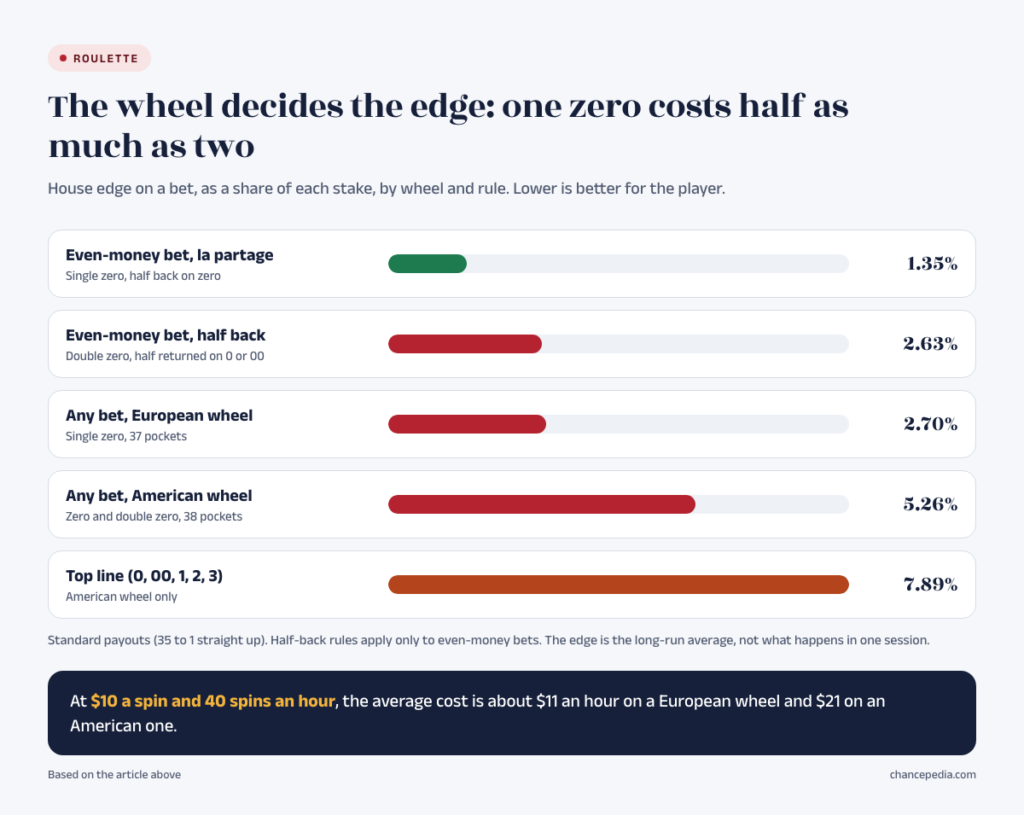
The second zero roughly doubles the cost of playing. The house edge rises from 2.70% on a European wheel to 5.26% on an American wheel, while the payouts stay the same. Over many spins, the same bets lose almost twice as much on the double-zero wheel.
To see what that means in money, take a steady $10 bet. The number of spins per hour varies by table and is an assumption here; 40 an hour is a fair figure for a busy live table.
| Wheel | House edge | Staked per hour ($10 × 40 spins) | Average cost per hour |
|---|---|---|---|
| European (single zero) | 2.70% | $400 | About $10.80 |
| American (double zero) | 5.26% | $400 | About $21.05 |
| European, even-money bets with la partage | 1.35% | $400 | About $5.40 |
Which roulette bet has the worst odds?
The top line bet on an American wheel has the worst odds in roulette. It covers 0, 00, 1, 2 and 3 and pays 6 to 1, but a five-number bet would need to pay 6.2 to 1 to match the rest of the table. Its house edge is 7.89%, half as much again as every other bet on the same wheel.
The maths: the bet wins 5 times in 38 and pays 6 units each time, so it gains 30 units. It loses 1 unit the other 33 times. That is a net loss of 3 units in 38 spins, or 7.89%. European wheels have no top line bet, so the problem only exists on double-zero tables.
Do la partage and half-back rules change roulette odds?
Yes, but only for even-money bets such as red or black. Under la partage, found on many French and some European tables, you get half your even-money stake back when the ball lands on zero. That halves the house edge on those bets from 2.70% to 1.35%. Inside bets keep the full 2.70%.
A similar option exists on double-zero wheels. New Jersey’s rule lets each casino choose whether a player loses half or all of an even-money bet when 0 or 00 comes up, and the choice must be posted at the table. Where half is returned, the edge on even-money bets drops from 5.26% to 2.63%. The rule does not apply to single-zero wheels there, where even-money bets lose in full on zero.
En prison is a related rule: instead of taking half back, your even-money bet stays on the table for the next spin. If it wins then, you get your stake back without winnings. Rules on what happens after a second zero vary, so check the table’s posted rules before relying on it.
Can a betting system improve your roulette odds?
No betting system changes roulette odds. Each spin is independent, every bet carries the same edge, and adding bets together adds their edges together. Systems such as doubling your stake after each loss change how often you win and how large the losses are, not the average loss per unit staked.
Doubling after losses, often called the Martingale, wins a small amount most of the time and occasionally loses a large amount, when a losing run meets the table limit or the end of your budget. Ten losses in a row at $10 a time already means a next bet of $10,240. Patterns on the results board are no help either: the wheel has no memory, and black has the same 18 chances in 37 after ten reds as after ten blacks.
What do roulette odds mean for a real session?
The house edge describes the average over many spins, not what happens tonight. Over a short session results swing widely, and many players finish ahead or behind by much more than the edge suggests. Over hundreds of spins the results settle closer to the average loss in the cost table above.
The bet you choose decides how bumpy the ride is. Even-money bets win almost half the time and lose in small steps. A single number wins about once in 37 spins, so long losing runs are normal and a session can end without a single win. Neither choice changes the average cost.
A simple way to stay in control is to decide your spending limit and your time limit before you start, and stop when you reach either one. The Chancepedia safer play toolkit explains how to set both, and the UK Gambling Commission’s safer gambling pages list more tools.
What should you check before you play roulette?
Look at the wheel first. A single zero costs half as much as a double zero, and a table with la partage halves the cost again on even-money bets. Skip the top line bet on American wheels, and treat any system that promises to beat the wheel as a sign to walk away.
For the other table games and how their odds compare, browse the casino table games section, or read more about odds, probability and strategy.